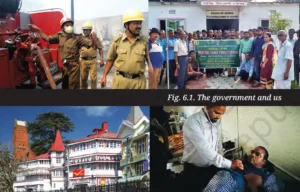
Important one mark questions for test preparation.
A. Multiple Choice Questions:
1. What is a state mainly defined as?
A. A political party
B. A group of rulers
C. A political organisation with authority over territory and people
D. A cultural group
Answer: C
2. Which of the following is NOT an essential feature of a state?
A. Permanent population
B. Defined territory
C. Sovereignty
D. Political party
Answer: D
3. What does sovereignty of a state mean?
A. Control by another country
B. Complete freedom to make laws without external control
C. Rule by a king
D. Power only over economy
Answer: B
4. Why is the government considered a part of the state?
A. It owns land
B. It represents culture
C. It runs the country on behalf of the state
D. It never changes
Answer: C
5. Why do people often confuse the terms ‘state’ and ‘government’?
A. They have the same meaning
B. Government is permanent
C. Government acts on behalf of the state
D. State changes after elections
Answer: C
6. Which organ of government is responsible for making laws?
A. Executive
B. Judiciary
C. Legislature
D. Police
Answer: C
7. What is the main role of the executive?
A. Interpreting laws
B. Making laws
C. Implementing laws and policies
D. Conducting elections
Answer: C
8. Which of the following is a function of the judiciary?
A. Framing budgets
B. Implementing schemes
C. Protecting citizens’ rights
D. Conducting foreign policy
Answer: C
9. What is the core idea of democracy?
A. Rule by king
B. Rule by officials
C. Rule by people
D. Rule by courts
Answer: C
10. Why is India called a republic?
A. It has a parliament
B. Its head of state is elected
C. It has many states
D. It has a constitution
Answer: B
11. Which country is a democracy but not a republic?
A. India
B. USA
C. UK
D. France
Answer: C
12. Why are limits placed on government power in a republic?
A. To weaken the state
B. To protect citizens’ rights
C. To favour the majority
D. To remove elections
Answer: B
13. What does ‘dominance of the majority’ mean?
A. Rule by the Constitution
B. Protection of minorities
C. Ignoring minority rights
D. Rule by judiciary
Answer: C
More MCQs:
14. Which body ensures checks and balances in India?
A. Parliament
B. Political parties
C. Constitution
D. Media
Answer: C
15. Who are part of the political executive?
A. IAS officers
B. Judges
C. Elected leaders
D. Police officers
Answer: C
16. Who are included in the permanent executive?
A. Ministers
B. Governors
C. Bureaucrats
D. MPs
Answer: C
17. Why does the permanent executive continue even after elections?
A. They are elected
B. They are appointed for life
C. They ensure continuity in administration
D. They control the government
Answer: C
18. Which service is responsible for maintaining law and order?
A. IAS
B. IPS
C. IFS
D. IRS
Answer: B
19. What is decentralisation?
A. Concentration of power
B. Transfer of power to one authority
C. Distribution of power to different levels
D. Removal of government
Answer: C
20. Why was the Panchayati Raj system introduced?
A. To strengthen monarchy
B. To centralise power
C. To strengthen democracy at grassroots
D. To reduce elections
Answer: C
21. Which level of government looks after defence?
A. Local
B. State
C. Central
D. District
Answer: C
22. Which level of government handles streetlights and drainage?
A. Central
B. State
C. Local
D. Judiciary
Answer: C
23. What does the Right to Information Act promote?
A. Secrecy
B. Corruption
C. Transparency and accountability
D. Control of media
Answer: C
24. Why is an independent judiciary important in a democracy?
A. To support rulers
B. To protect rule of law
C. To run elections
D. To make policies
Answer: B
25. Which role of government includes providing education and healthcare?
A. Protector
B. Provider
C. Regulator
D. Observer
Answer: B
B. True or False:
A state can exist without a population. True
Government is a permanent feature of a state. False
India is both a democracy and a republic. True
The judiciary is controlled by the executive. False
Police are part of the state government. True
Bureaucrats are elected by people. False
Decentralisation strengthens democracy. True
The Constitution limits government power. True
RTI promotes transparency. True
Local governments solve national defence issues. False
Match the Following:
| Column A | Column B |
|---|---|
| (a) Democracy | (i) Elected head of state |
| (b) Republic | (ii) Supreme law |
| (c) Constitution | (iii) Rule by people |
Answer:
(a) – (iii)
(b) – (i)
(c) – (ii)
| Column A | Column B |
|---|---|
| (a) Legislature | (i) Interprets laws |
| (b) Executive | (ii) Makes laws |
| (c) Judiciary | (iii) Implements laws |
Answer:
(a) – (ii)
(b) – (iii)
(c) – (i)
| Column A | Column B |
|---|---|
| (a) Sovereignty | (i) Distribution of power |
| (b) Decentralisation | (ii) Supreme authority |
| (c) Republic | (iii) Elected head of state |
Answer:
(a) – (ii)
(b) – (i)
(c) – (iii)
| Column A | Column B |
|---|---|
| (a) Central Government | (i) Streetlights |
| (b) State Government | (ii) Defence |
| (c) Local Government | (iii) Police |
Answer:
(a) – (ii)
(b) – (iii)
(c) – (i)
| Column A | Column B |
|---|---|
| (a) IAS | (i) Law and order |
| (b) IPS | (ii) District administration |
| (c) IFS | (iii) Foreign relations |
Answer:
(a) – (ii)
(b) – (i)
(c) – (iii)
| Column A | Column B |
|---|---|
| (a) RTI Act | (i) Rule of law |
| (b) Judiciary | (ii) Transparency |
| (c) Constitution | (iii) Supreme law |
Answer:
(a) – (ii)
(b) – (i)
(c) – (iii)
Assertion–Reasoning:
1. Assertion: India is a democratic republic.
Reason: The head of state in India is elected and power is limited by the Constitution.
Answer: Both A and R are true and R explains A.
2. Assertion: Government power must be limited.
Reason: Unlimited power can violate citizens’ rights.
Answer: Both A and R are true and R explains A.
3. Assertion: The judiciary is called the watchdog of democracy.
Reason: It ensures laws are followed and rights are protected.
Answer: Both A and R are true and R explains A.
4. Assertion: Decentralisation improves governance.
Reason: Local problems are best solved at the local level.
Answer: Both A and R are true and R explains A.
5. Assertion: Bureaucrats play an important role in governance.
Reason: They implement laws and ensure continuity of administration.
Answer: Both A and R are true and R explains A.
To Learn more Click Below:
MCQs:
Chapter 1-The Story of Indian Farming – CLICK HERE
Chapter 2 – India and Her Neighbours – CLICK HERE
Chapter 3 – Empire and Kingdoms: 6th to 10th Centuries – CLICK HERE
Chapter 4 -Turning tides: 11th and 12th Centuries – CLICK HERE
Chapter 5 – India: A Home to Many- CLICK HERE
Chapter 6 – The State, the government and You- CLICK HERE
Chapter 7 – Infrastructure: Engine of India’s Development – CLICK HERE
Chapter 8 – Banks and the Magic of Finance- CLICK HERE