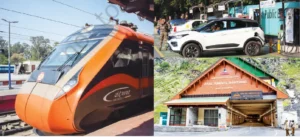
Important and Hot MCQs for Chapter 7 – Infrastructure: Engine of India’s Development Subject Social Science Class 7
A. Multiple Choice Questions:
What is meant by physical infrastructure?
(a) Natural resources only
(b) Government rules and laws
(c) Tangible structures like roads, power, and communication
(d) Cultural traditions
Ans: (c)
Which of the following is NOT a part of physical infrastructure?
(a) Roads
(b) Railways
(c) Hospitals
(d) Internet cables
Ans: (c)
Why is physical infrastructure called the backbone of a nation?
(a) It controls population
(b) It supports daily life and economic activities
(c) It preserves culture
(d) It creates laws
Ans: (b)
Which transport system connects villages, towns, and cities most widely in India?
(a) Airways
(b) Shipping
(c) Roadways
(d) Metro rail
Ans: (c)
India has the world’s second-largest road network after which country?
(a) China
(b) Russia
(c) USA
(d) Brazil
Ans: (c)
Which body maintains national highways in India?
(a) Panchayat
(b) State government
(c) Central government
(d) Municipal corporation
Ans: (c)
What is the main purpose of bridges like the Dhola–Sadiya Bridge?
(a) Tourism only
(b) Defence training
(c) Year-round connectivity in difficult terrain
(d) Flood control
Ans: (c)
Living root bridges are found mainly in:
(a) Assam
(b) Kerala
(c) Meghalaya
(d) Sikkim
Ans: (c)
Which community builds living root bridges?
(a) Santhal
(b) Khasi and Jaintia
(c) Bhil
(d) Toda
Ans: (b)
When were railways introduced in India?
(a) 1800
(b) 1853
(c) 1901
(d) 1947
Ans: (b)
Why did the British introduce railways in India?
(a) For tourism
(b) To help Indian farmers
(c) To transport raw materials and troops
(d) For environmental protection
Ans: (c)
Today, Indian Railways is among the world’s:
(a) Smallest networks
(b) Costliest services
(c) Largest railway systems
(d) Private railways
Ans: (c)
Which fuel is Indian Railways increasingly using to reduce pollution?
(a) Coal
(b) Diesel
(c) Electricity
(d) Petrol
Ans: (c)
More MCQs:
Metro rail systems help cities mainly by:
(a) Increasing road traffic
(b) Reducing pollution and travel time
(c) Increasing vehicle ownership
(d) Raising fuel use
Ans: (b)
Which Indian metro uses solar power?
(a) Mumbai Metro
(b) Kolkata Metro
(c) Chennai Metro
(d) Delhi Metro
Ans: (d)
Which mode of transport is the fastest?
(a) Roadways
(b) Railways
(c) Airways
(d) Waterways
Ans: (c)
Air transport is especially useful during:
(a) Festivals
(b) Disasters
(c) Elections
(d) Harvest seasons
Ans: (b)
India has approximately how many airports (2025)?
(a) 50
(b) 100
(c) 159
(d) 300
Ans: (c)
Shipping is preferred for transporting:
(a) Light goods only
(b) Heavy goods over long distances
(c) Passengers only
(d) Emergency services
Ans: (b)
India has how many major ports?
(a) 6
(b) 8
(c) 10
(d) 12
Ans: (d)
What does TEU measure?
(a) Ship speed
(b) Cargo weight
(c) Container capacity
(d) Fuel usage
Ans: (c)
Communication infrastructure includes:
(a) Roads and bridges
(b) Courts and schools
(c) Cables, towers, and satellites
(d) Forests and rivers
Ans: (c)
Who pioneered wireless transmission in India?
(a) C.V. Raman
(b) J.C. Bose
(c) Homi Bhabha
(d) A.P.J. Abdul Kalam
Ans: (b)
E-governance mainly helps citizens by:
(a) Increasing paperwork
(b) Making services faster and easier
(c) Limiting access
(d) Raising costs
Ans: (b)
Caring for public infrastructure is:
(a) Government’s duty only
(b) Citizens’ duty only
(c) A collective responsibility
(d) Optional
Ans: (c)
B. True / False:
Physical infrastructure includes roads, power, and communication. (T)
India has the largest road network in the world. (F)
Living root bridges are man-made concrete structures. (F)
Indian Railways carries millions of passengers daily. (T)
Metro trains increase road congestion. (F)
Air transport helps reach difficult terrains during disasters. (T)
Shipping is the costliest mode of transport. (F)
Communication infrastructure supports e-commerce and education. (T)
J.C. Bose patented all his inventions widely. (F)
Public infrastructure should be used responsibly by citizens. (T)
C. Match the Following:
Set 1
A. National Highway — (i) Central Government
B. Living Root Bridge — (ii)Urban transport
C. Metro Rail — (iii) Meghalaya
Ans: A-i, B-iii, C-ii
Set 2
A. Shipping — (i) Mass transport
B. Airways — (ii) Heavy goods
C. Railways — (iii) Fastest transport
Ans: A-ii, B-iii, C-i
Set 3
A. J.C. Bose — (i) Wireless transmission
B. Internet — (ii) Digital communication
C. Ports — (iii) Trade gateways
Ans: A-i, B-ii, C-iii
Set 4
A. TEU — (i) Reduced pollution
B. Metro — (ii) Container unit
C. Highways — (iii) Inter-state travel
Ans: A-ii, B-i, C-iii
Set 5
A. E-governance — (i) Online services
B. Social infrastructure — (ii) Hospitals, schools
C. Physical infrastructure — (iii) Roads, power
Ans: A-i, B-ii, C-iii
D. Assertion–Reasoning:
Assertion: Infrastructure improves quality of life.
Reason: It enables access to transport, water, power, and communication.
Ans: Both A and R are true, and R explains A.Assertion: Railways consume less energy than road transport.
Reason: Goods trains use 75–90% less energy than trucks.
Ans: Both A and R are true, and R explains A.Assertion: Living root bridges last for hundreds of years.
Reason: They are made of steel and concrete.
Ans: A is true, R is false.Assertion: Communication infrastructure supports education in remote areas.
Reason: Students can access online classes and digital libraries.
Ans: Both A and R are true, and R explains A.Assertion: Damaging public property affects all citizens.
Reason: Repair costs become a burden on society.
Ans: Both A and R are true, and R explains A.
To Learn more Click Below:
MCQs:
Chapter 1-The Story of Indian Farming – CLICK HERE
Chapter 2 – India and Her Neighbours – CLICK HERE
Chapter 3 – Empire and Kingdoms: 6th to 10th Centuries – CLICK HERE
Chapter 4 -Turning tides: 11th and 12th Centuries – CLICK HERE
Chapter 5 – India: A Home to Many- CLICK HERE
Chapter 6 – The State, the government and You- CLICK HERE
Chapter 7 – Infrastructure: Engine of India’s Development – CLICK HERE
Chapter 8 – Banks and the Magic of Finance- CLICK HERE