Important In Text and exercise Questions
The Big Questions?
1. What has made India a home for people from different parts of the world?
Answer:
India has a long history of contact with other regions through trade and travel.
It lies on important land and sea routes, which brought people from many places.
India has always shown tolerance towards different cultures and beliefs.
People were attracted by India’s rich culture, learning centres, and resources.
Over time, people from different parts of the world settled and lived peacefully here.
2. Why did oppressed or persecuted people from other countries seek refuge in India?
Answer:
Many people faced religious or political persecution in their own countries.
India offered them safety, freedom, and shelter.
Indian rulers and society were generally accepting and kind to refugees.
People were allowed to follow their own religion and customs.
This made India a safe home for the oppressed.
3. What is it about the nature of Indian society that enables people to assimilate here?
Answer:
Indian society values diversity and coexistence.
It respects different religions, languages, and traditions.
New communities were allowed to keep their identity.
At the same time, they adopted local customs and ways of life.
This helped people to blend into Indian society peacefully.
Questions and activities:
1. On the outline of a world map, try to trace the routes that the communities mentioned in this chapter may have used to reach India. What types of physical geographies did they have to negotiate?
Answer:
Many communities came to India through land routes like the north-west passes (Khyber and Bolan).
Some arrived by sea routes along the Arabian Sea and Bay of Bengal.
They crossed mountains, deserts, rivers, forests, and seas.
Traders and migrants used ancient trade routes connecting India with Central Asia, West Asia, and Southeast Asia.
These routes helped people from different regions reach India and settle here.
2. What are the key values intrinsic to Indian culture that enable it to welcome people of different backgrounds?
Answer:
Tolerance and respect for different religions and beliefs.
Belief in peaceful coexistence.
Acceptance of many languages, customs, and food habits.
Freedom to follow one’s own faith and traditions.
A long tradition of hospitality and inclusiveness.
Questions and activities:
3. Homi Bhabha, Sam Maneckshaw, Ratan Tata, Fali Nariman, Nani Palkivala, and Cornelia Sorabji are a few names of Parsis who excelled in their respective fields. Find out more about people from other communities that made India their home and their contributions.
Answer:
Mother Teresa (Christian community): Worked for the poor and sick.
Abdul Ghaffar Khan (Pathan): Freedom fighter and follower of non-violence.
Rabindranath Tagore (Bengali community): Poet and Nobel Prize winner.
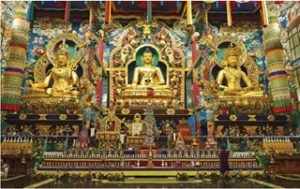
Dalai Lama (Tibetan community): Promoted peace and compassion in India.
Jamsetji Tata (Parsi community): Pioneer of Indian industry.
These people enriched India in education, social service, freedom movement, and industry.
4. Take up a class project. Divide the class into groups. Each group takes up a small project to study a little more about the communities that we have been listed here. Share what you have gathered with your classmates through one of these ways — drama, posters, song, painting, etc.
Answer:
Class project on communities in India (Sample Answer)
The class can be divided into small groups.
Each group studies one community mentioned in the chapter.
Students collect information about their history, culture, food, dress, and contributions.
They present their findings through posters, dramas, songs, paintings, or skits.
This activity helps students understand unity in diversity.
To Learn more Click Below:
NCERT Solutions:
Chapter 1-The Story of Indian Farming – CLICK HERE
Chapter 2 – India and Her Neighbours – CLICK HERE
Chapter 3 – Empire and Kingdoms: 6th to 10th Centuries – CLICK HERE
Chapter 4 -Turning tides: 11th and 12th Centuries – CLICK HERE
Chapter 5 – India: A Home to Many- CLICK HERE
Chapter 6 – The State, the government and You- CLICK HERE
Chapter 7 – Infrastructure: Engine of India’s Development – CLICK HERE
Chapter 8 – Banks and the Magic of Finance- CLICK HERE
MCQs:
Chapter 1-The Story of Indian Farming – CLICK HERE
Chapter 2 – India and Her Neighbours – CLICK HERE
Chapter 3 – Empire and Kingdoms: 6th to 10th Centuries – CLICK HERE
Chapter 4 -Turning tides: 11th and 12th Centuries – CLICK HERE
Chapter 5 – India: A Home to Many- CLICK HERE
Chapter 6 – The State, the government and You- CLICK HERE
Chapter 7 – Infrastructure: Engine of India’s Development – CLICK HERE
Chapter 8 – Banks and the Magic of Finance- CLICK HERE
Source Based Questions:
The Story of Indian Farming – CLICK HERE
Pingback: NCERT Solutions-Chapter 8-Banks and the Magic of Finance -
Pingback: NCERT Solutions-Infrastructure:Engine of India’s Development
Pingback: NCERT Solution-Chapter 6-The State, the Government, and You
Pingback: NCERT Solutions-Chapter 4-Turning Tides 11 and 12 Centuries
Pingback: NCERT Solution-Chapter-3 Empires and Kingdoms-Class 7 SST
Pingback: NCERT Solutions-Chapter2-India and Her Neighbours-Class7-SSt