In Text Solutions for How I Tought My Garndmother to Read in Class 9 Subject English
Reflect and Respond
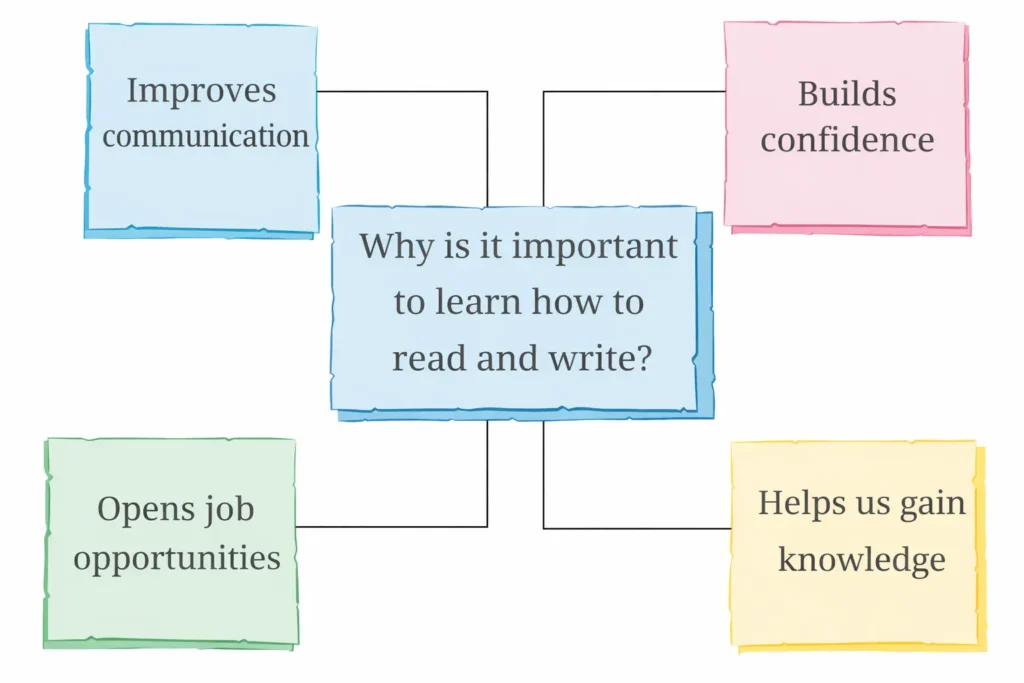
II. Read the questions given below and share your answer with your classmates and teacher.
1. Which language(s) do your grandparents or elderily relatives speak?
Answer: My grandparents speak Punjabi and Hindi. (any other as per your opinion or region)
2. How do they spend their time? How do you spend time with them?
Answer: They spend time reading newspapers, watching TV, and praying. I talk to them and help them with mobile phones. (any other reletive point).
3. What is your favourite experience with them?
Answer: My favourite experience is listening to their childhood stories. (any other reletive point).
4. What is something that the elderly in your family cannot do easily but they enjoy watching you do?
Answer: They cannot use smartphones easily but enjoy watching me use them. (any other reletive point).
Read the following passage. Match the highlighted words with their meaning given in the box below:
Answer:
Vocabulary (Matching)
(i) protagonist → 7. main character
(ii) debate → 4. discussion
(iii) episode → 5. part of a story
(iv) community → 3. people living in one particular area
(v) concentration → 6. focus
(vi) eagerly → 1. excitedly
(vii) convincing → 2. believable
(viii) guided → 1. directed
Check Your Understanding
Complete the cause and effect table given below based on part I of the story. Share your answer with classmates and teacher.
Answer: Cause–Effect Table
| Cause | Effect |
|---|---|
| 1. Morning papers arrived late; weekly magazines one day late. | Everyone waited eagerly for the bus carrying papers and magazines. |
| 2. Grandmother never went to school. | She could not read herself. |
| 3. She was deeply interested in the story. | She discussed it with her friends. |
| 4. Narrator went to a wedding for a week. | Grandmother missed the story and cried. |
| 5. Grandmother never went to school. | She regretted not being educated. |
| 6. Grandmother regretted not going to school. | She decided to learn the Kannada alphabet. |
II. Do you think the narrator expected to see her grandmother in tears when she returned to the village? If yes, why? If no, why not?
Answer: No, the narrator did not expect to see her grandmother in tears.
She was surprised because she had never seen her cry even in the most difficult situations. The narrator had gone to a wedding and was unaware that her grandmother had been waiting eagerly for her to return and read the next episode of Kashi Yatre. Her grandmother’s emotional reaction was unexpected and deeply moving.
III. How might the narrator help her grandmother to fulfil her desire to learn to read and write?Answer: The narrator could help her grandmother by becoming her teacher. She could start teaching her the Kannada alphabet, give her regular practice, and encourage her to read and write daily. In the story, the narrator does exactly that—she begins tuition the very next day and helps her grandmother achieve her goal by Dassara.
Critical Reflection
Extract 1 Answers:
1. Grandmother was strong-willed.
2. She was too emotional to reply.
3. Rural setting clue: “temple courtyard… sleeping in the open terrace on a summer night.”
4. Tender atmosphere: “Her affectionate hands touched my forehead.”
5. Aspect NOT emphasised: C. regret over lack of education.
Extract 2 Answers:
1. “I want to be independent” → shows her desire for self-sufficiency.
2. Learning has no age limit.
3. Narrator laughed because she assumed sixty-two was too old to learn.
4. Qualities: Determination, Patience, Courage, Hard work.
5. Narrator assumed age and appearance were barriers to learning.
II. Answer the following questions:
1. Why do you think the grandmother felt embarrassed to ask someone else to read to her while the narrator was away?
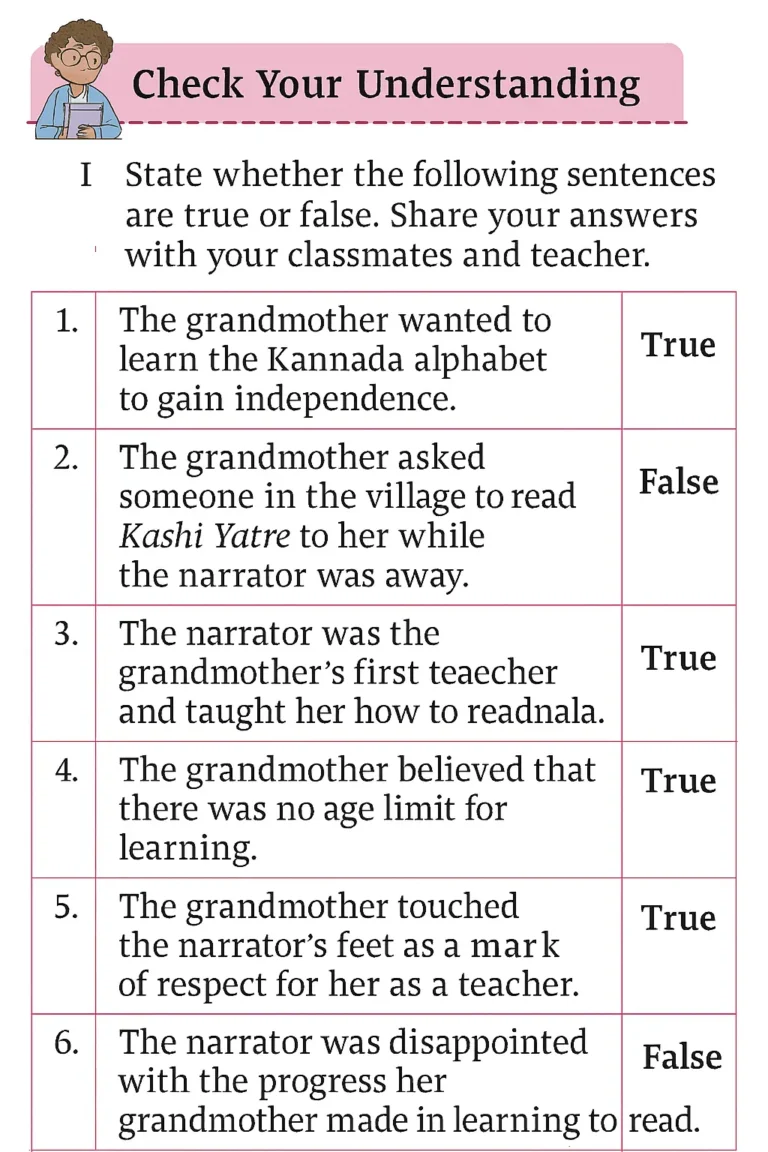
Answer: The grandmother felt embarrassed because she was illiterate and didn’t want others to know that she couldn’t read. She felt dependent and helpless, and asking someone else would have exposed her vulnerability.
2. Why does the narrator initially laugh at her grandmother’s determination to learn at the age of sixty-two?
Answer: The narrator laughed because she assumed that sixty-two was too old to start learning. She was surprised that someone with grey hair, spectacles, and wrinkled hands wanted to learn the alphabet.
3. What significance does the story of Kashi Yatre have in both the grandmother’s life and the story?
Answer: Kashi Yatre deeply resonated with the grandmother because she identified with the protagonist’s desire and sacrifice. It became her motivation to learn reading so she could independently enjoy such stories.
4. What does the grandmother’s desire to learn the Kannada alphabet reflect about her?
Answer: It reflects her strong determination, self-respect, and belief that learning has no age limit. She wanted to be independent and not rely on others to read for her.
5. What lessons can we infer from the grandmother’s action of touching the narrator’s feet?
Answer: It teaches us that respect for teachers transcends age and relationships. The grandmother honored her granddaughter as a teacher, showing humility and reverence for learning.
6. What does the following line tell us about the broader theme of the story?
“For a good cause if you are determined, you can overcome any obstacle.”
Answer: This line highlights the theme of perseverance and lifelong learning. It shows that determination can help overcome limitations like age, lack of education, or societal expectations.
7. How effectively does the story highlight the value of education in supporting personal independence?
Answer: The story powerfully illustrates that education empowers individuals, regardless of age. The grandmother’s journey from dependence to independence through learning showcases the transformative power of literacy.