Exercise Question Answer for class 7 Subject Social Science for Chapter 4 – “Turning Tides: 11th and 12th Centuries
The Big Questions?
1. Why are the 11th and 12th centuries seen as a period of transition in Indian history?
Answer:
Old regional kingdoms became weaker during this time.
New powers rose in different parts of India.
Foreign invasions increased from the north-west.
Political control shifted from many small rulers to new rulers.
Despite changes, Indian culture and traditions continued.
2. Which new powers emerged during this period? What were the essential features of their economic, military and administrative systems?
Answer:
New powers included the Cholas, Hoysalas, Kakatiyas, Paramaras and Chahamanas.
Their economy depended on agriculture, land revenue and trade.
Strong armies and forts were maintained for defence.
Kings ruled with the help of officials and local chiefs.
Some kingdoms, like the Cholas, also developed a powerful navy.
3. What high accomplishments in art, architecture, literature, science, etc., do we come across during this period?
Answer:
Many magnificent temples were built in stone.
Chola temples like Brihadeeshwara show advanced architecture.
Literature grew in Sanskrit and regional languages.
Scholars like Bhaskaracharya advanced mathematics and astronomy.
Sculpture and bronze art reached a high level of excellence.
Questions and activities:
Q1. Why is the period under consideration in this chapter regarded as a major transition in Indian history? Give two examples each of change and continuity from this period.
Answer:
Changes
New dynasties replaced older political powers.
Foreign invasions became more frequent and influential.
Continuities
3. Temple building traditions continued.
4. Indian languages, religion and learning remained strong.
Q2. Observe Fig. 3.27 in the previous chapter and draw a similar ‘star of dynasties’ gathering all or most of the dynasties that appear in this chapter.
Answer:
Place the Cholas at one point of the star.
Add Hoysalas, Kakatiyas, Paramaras, Chahamanas around it.
Connect them to show that they ruled at the same time.
This shows India had many powerful dynasties together.
It highlights political diversity of the period.
Q3. Taking a map of the Subcontinent, draw a geographical tour that covers all or most dynasties in this chapter (you may draw inspiration from some of the ‘travels’ the chapter’s narration follows).
Answer:
Start from Cholas in Tamil Nadu.
Move to Hoysalas in Karnataka.
Go north to Kakatiyas in Telangana.
Then reach Paramaras in central India.
End with Chahamanas in north-western India.
Q4. With the help of a map of India and Southeast Asia, can you calculate the approximate distance that Rājendra I’s fleet of ships had to navigate to reach their objective?
Answer:
Rajendra I sailed from the Tamil Nadu coast.
His fleet crossed the Bay of Bengal.
It reached Southeast Asia (Srivijaya region).
The distance was several thousand kilometres.
This shows the strength of the Chola navy.
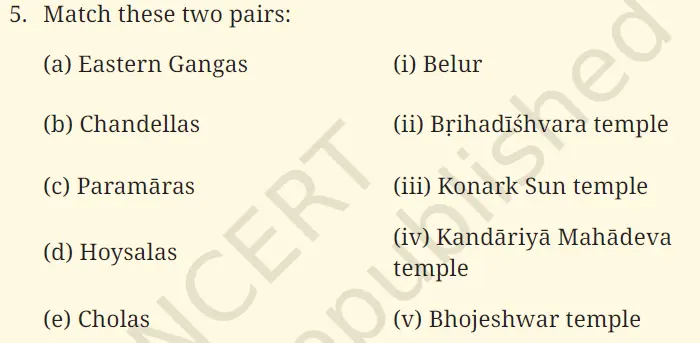
Q5: Match the following:
Answer:
(a) – (iii)
(b) – (iv)
(c) – (ii)
(d) – (v)
(e) – (i)
6. Working in groups, compare the dynasties in this chapter and in the preceding one; create a table to list the dynasties present in both, those that disappear from the preceding period, and those that appear in this chapter’s period.
Answer:
Dynasties like Palas and Pratiharas disappear.
Cholas, Hoysalas and Kakatiyas appear strongly.
Some regions continue with new rulers.
Political centres shift across regions.
This shows change in power but continuity of governance.
7. Using the chapter and any additional reading, prepare a short note explaining (1) why centres of learning like Nālandā were important; (2) how their destruction may have affected education and culture in India.
Answer:
Nalanda was a famous centre of education.
Students came from India and other countries.
Many subjects like religion, science and philosophy were taught.
Its destruction caused loss of knowledge and libraries.
Education and cultural exchange were badly affected.
8. Why do you think Mahmūd of Ghazni carry out repeated raids from Afghanistan into India, while Muhammad Ghūrī sought territorial expansion into India and long-term control? Write a short note on how their motives shaped the outcomes of their campaigns.
Answer:
Mahmud of Ghazni wanted wealth and treasure.
He did not plan to rule India permanently.
Muhammad Ghuri wanted territorial expansion.
He defeated Indian rulers to control land.
His campaigns led to long-term political change in India.
To Learn more Click Below:
NCERT Solutions:
Chapter 1-The Story of Indian Farming – CLICK HERE
Chapter 2 – India and Her Neighbours – CLICK HERE
Chapter 3 – Empire and Kingdoms: 6th to 10th Centuries – CLICK HERE
Chapter 4 -Turning tides: 11th and 12th Centuries – CLICK HERE
Chapter 5 – India: A Home to Many- CLICK HERE
Chapter 6 – The State, the government and You- CLICK HERE
Chapter 7 – Infrastructure: Engine of India’s Development – CLICK HERE
Chapter 8 – Banks and the Magic of Finance- CLICK HERE
MCQs:
Chapter 1-The Story of Indian Farming – CLICK HERE
Chapter 2 – India and Her Neighbours – CLICK HERE
Chapter 3 – Empire and Kingdoms: 6th to 10th Centuries – CLICK HERE
Chapter 4 -Turning tides: 11th and 12th Centuries – CLICK HERE
Chapter 5 – India: A Home to Many- CLICK HERE
Chapter 6 – The State, the government and You- CLICK HERE
Chapter 7 – Infrastructure: Engine of India’s Development – CLICK HERE
Chapter 8 – Banks and the Magic of Finance- CLICK HERE
Source Based Questions:
The Story of Indian Farming – CLICK HERE
Pingback: NCERT Solutions-Chapter 5-India, a Home to Many-Class 7 SST