Class 6 Social Science Periodic Test-1 Based on New Split-Up Syllabus
Introduction
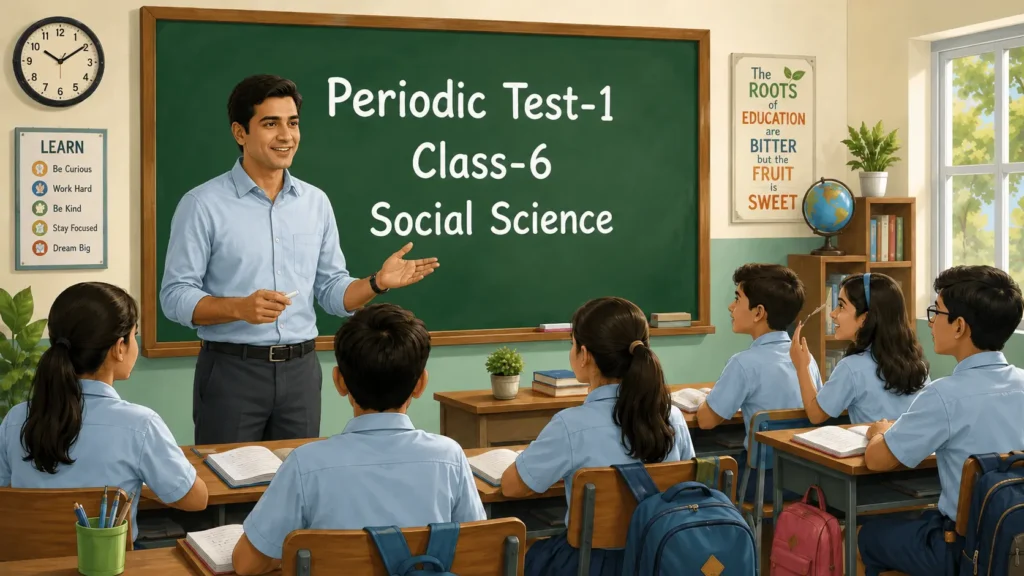
Periodic tests are an important part of the teaching-learning process. They help teachers understand how much students have learned after completing the prescribed syllabus. Therefore, I have prepared a complete Periodic Test-1 for Class 6 Social Science according to the new split-up syllabus. This paper is useful for both teachers and students because it includes a proper blueprint, a 40 marks question paper and a complete answer key.
Moreover, the paper has been designed to assess not only memory-based learning but also understanding, writing skills, source analysis and map skills. As a result, students get a balanced opportunity to show their knowledge in different ways.
About This Periodic Test-1
This Class 6 Social Science Periodic Test-1 has been prepared for classroom assessment and revision practice. It follows a clear and student-friendly structure. In addition, the paper includes objective, very short answer, short answer, long answer, case study/source-based and map-based questions.
The total marks for the paper are 40 marks, and there are 19 questions in total. All questions are compulsory. Therefore, students should read each question carefully and answer according to the marks allotted.
Question Paper Pattern
The paper follows the given pattern:
Question numbers 1 to 10 are Multiple Choice Questions and carry 1 mark each. These questions check basic understanding and concept clarity.
Question numbers 11 to 12 are very short answer type questions and carry 2 marks each. These questions help students write brief and accurate answers.
Question numbers 13 to 14 are short answer type questions and carry 3 marks each. These questions test explanation skills and conceptual understanding.
Question numbers 15 to 16 are long answer type questions and carry 5 marks each. These questions allow students to present detailed answers with proper points.
Question numbers 17 to 18 are case study/source-based questions and carry 4 marks each. These questions encourage students to read the given source carefully, analyse the situation and answer logically.
Finally, question number 19 is a map-based question and carries 2 marks. This helps assess geographical understanding and map-pointing skills.
Key Features of the Paper
This paper is based on the new split-up syllabus. In addition, it includes a proper blueprint, balanced marks distribution and a complete answer key. Furthermore, the questions are arranged in a simple and systematic way so that students can attempt the paper confidently.
The paper also includes competency-based questions. Therefore, students are encouraged to think, analyse and apply their learning instead of only memorising facts.
Why This Paper Is Useful
This Periodic Test-1 is useful for regular classroom assessment. Teachers can use it to evaluate students’ progress after completing the syllabus. At the same time, students can use it for revision and self-practice before exams.
Additionally, the answer key makes checking easier and helps students understand the expected answers. Thus, this resource saves time for teachers and supports better preparation for students.
Download Class 6 Social Science Periodic Test-1
Teachers and students can download the complete test package from the links below:
Download Blueprint: CLICK HERE
Download Question Paper:
Paper 1 – CLICK HERE
Paper 2 – CLICK HERE
Paper 3 – CLICK HERE
Paper 4 – CLICK HERE
Paper 5 – CLICK HERE
Download Answer Key:
Paper 1 – CLICK HERE
Paper 2 – CLICK HERE
Paper 3 – CLICK HERE
Paper 4 – CLICK HERE
Paper 5 – CLICK HERE
Download Class 6 Social Science LAT PAPERS
Conclusion
Overall, this Class 6 Social Science Periodic Test-1 is a complete and useful assessment resource. It follows the new split-up syllabus and includes different types of questions to assess knowledge, understanding, critical thinking and map skills. Therefore, it can be used confidently by teachers for classroom assessment and by students for effective revision.
Pingback: Class 6 Social Science Half Yearly Papers with Answer Key